Why we invested in Project Q
For decades, defence procurement bought platforms. But the modern battlefield is decided by data, and today that data sits in silos. Project Q is building the layer that connects it all.
That's why we invested.
The problem
Europe's security architecture was built for a different era. Every sensor, effector, and mission system on a modern battlefield or around a critical site generates data, but almost none of it talks to each other. Systems are vendor-locked, procured platform by platform, and integrated (if at all) through expensive, bespoke projects.
Meanwhile, the threat picture has changed. Ukraine faces 800+ drones and missiles per night targeting its critical infrastructure. In Germany alone, more than 2,500 critical infrastructure and military sites remain effectively unprotected. The battle is no longer about individual platforms. It is about integration and speed of decision, and for that there is no scalable, open, market-ready layer in Europe today.
The market
Defence and critical infrastructure protection is one of the fastest-growing spending categories in Europe: NATO targets moving towards 3% of GDP, the €800bn ReArm Europe plan, and dedicated EU instruments explicitly funding sovereign supply chains and integration software. The Bundeswehr alone has committed roughly €3bn to end-to-end information systems through 2029. Billions flow into sensors, drones, and effectors, yet the layer that makes them work together has remained largely unoccupied. US-driven alternatives exist but raise sovereignty concerns for European buyers.
The solution
Project Q is building the orchestration layer of Europe's "Internet of Defence" - the software fabric that lets sensors, effectors and mission systems from any vendor talk to each other in real time.
At its core sits HYDRIS, an open-core, API-first platform that connects heterogeneous sensors, fuses their data at the edge and feeds mission systems in real-time, even in disconnected, low-bandwidth environments. One integration replaces dozens of bespoke ones: detection, classification, prioritisation, and response become a single workflow.
The open-core approach is the decisive difference. Rather than building another closed, proprietary stack, Project Q is replicating the playbook that turned Linux and Kubernetes into infrastructure defaults: the fastest realistic path to a European standard. The core is free, while customer-specific applications, premium connectors, hardware and managed deployments are paid. And the model is explicitly dual-use: armed forces today, civil critical infrastructure operators such as airports, ports and energy tomorrow.
Why we're convinced
Our conviction rests on the combination of team, positioning, and execution.
The team. Founders Leonard Wessendorff and Philipp Bartkowski built Project Q out of conviction, not opportunity. Together with their experienced team, they combine backgrounds spanning Hensoldt, the Bundeswehr, Tesla and top-tier consulting, and understand defence procurement, sensor technology, and software scaling.
The positioning. Project Q does not compete with primes on sensors or effectors. It sits one layer above, as the vendor-neutral integration fabric - a category that is largely empty in Europe. Incumbents push closed stacks; an open, vendor-neutral platform creates network effects they structurally cannot replicate.
The execution. Within 18 months of incorporation, Project Q went from launch to contracted revenue, with confirmed design wins across the Bundeswehr and commercial maritime customers. A live testbed runs in Berlin, and the platform is already integrated with established mission systems. Once embedded in a customer's operations, it becomes the connective tissue that makes missions succeed.
That's why we invested.

Read more
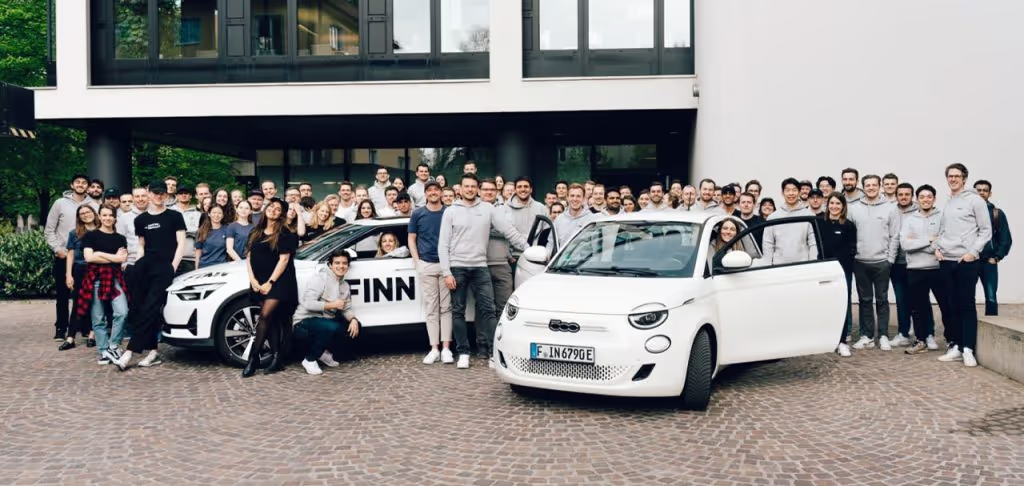
Heliad Equity Partners participates with a single digit million amount in FINN’s series B funding round
Frankfurt am Main, 31st of May 2022 – Heliad Equity Partners GmbH & Co. KGaA (ISIN: DE000A0L1NN5) welcomes FINN to

468 SPAC I SE, an investment of Heliad, successfully completes its business combination with Boxine GmbH
Frankfurt am Main, 26 November 2021 – Boxine GmbH, a cloud-connected kid’s audio entertainment business and the company behind the

Heliad invests in Gaia to develop fertility care with outcome-based financing
Frankfurt am Main, January 28, 2025 – Heliad, through its early-stage investment arm Collective Ventures, has announced its participation in