Why we invested in bayshore AI
For a long time, compliance was a cost to be managed, instead of a process to be automated. That is starting to change. And bayshore sits the inflection point.
That's why we invested.
The problem
Europe's largest companies are drowning in regulation. The EU alone has introduced roughly 13,000 new legislative acts in recent years – a pace that stretches every in-house legal and compliance team to its limits. European Commission studies put the annual tax-compliance cost for European businesses at an average of around 1.9% of turnover, and rising.
For a large enterprise, that translates into thousands of siloed policies spread across employment law, data privacy, export controls, and regulation. Most employee questions end up with a handful (or sometimes hoardes) of compliance personnel. The result is queues, liability gaps and oftentimes distraction from what really matters. And decisions that are documented nowhere.
The overwhelming share of this effort is borne by highly paid specialists and external service providers. It is one of the last large corners of the enterprise world that remains almost entirely manual.
The market
Compliance is not a niche. It is one of the largest remaining cost categories inside large organizations that still relies almost entirely onmanual labor. Billions have already been invested in adjacent categories – legal AI, GRC suites, enterprise workflow. The actual execution layer, where a regulation becomes a defensible decision, has remained largely unoccupied.
The solution
Bayshore is building the autonomous compliance and legal operations layerfor large enterprises.
At its core sits a purpose-built rules language that translates policies andregulations into deterministic, auditable decision graphs. This is the decisive difference from purely generative AI approaches: the same question always yields the same answer, every decision is traceable, and every step can be defended in front of a regulator.
AI is used where it genuinely adds value: Translating policies and regulations into code. The actual decision logic stays deterministic. The result is an end-to-end path: from a natural-language policy, to a rule, to an automated decision with a complete, regulator-ready audit trail.
Bayshore’s enterprise platform then reintroduces AI at the business end so that interaction feels simple for employees: Asking questions and initiating processes via familiar interfaces – and instant answers, backed by the exact policy clause it relies on. A queue at the compliance officers’ desks becomes a decision in seconds.
Why we're convinced
Three things came together at bayshore that rarely appear at once.
An exceptional team for exactly this market. The three founders – Philipp Wiegand, Paul F. Welter, and Erik Krauter – combine legal depth, AI research, and full-stack engineering. Their backgrounds span TUM, Stanford, and ETH Zurich. This is a team that understands the problem from the legal, the technical, and the commercial angle at the same time.
A product that does what incumbents and AI-only solutions can't. Existing players are either repositories of regulations, workflow tools, orassistants built for legal teams but none of them decides in a way that is traceable and regulatorily defensible. That very execution layer is what has been left open.
Early, real market validation. Bayshore went live with large, listed enterprises within months of launch. The nature of those deployments (infrastructure deeply ingrained into processes and systems) shows that enterprise buyers see something foundational here. Once a process runs on Bayshore, switching back is expensive and unattractive. In fact, there is already evidence that customers rather seek to expand implementation within and across divisions.
That's why we invested.

Read more
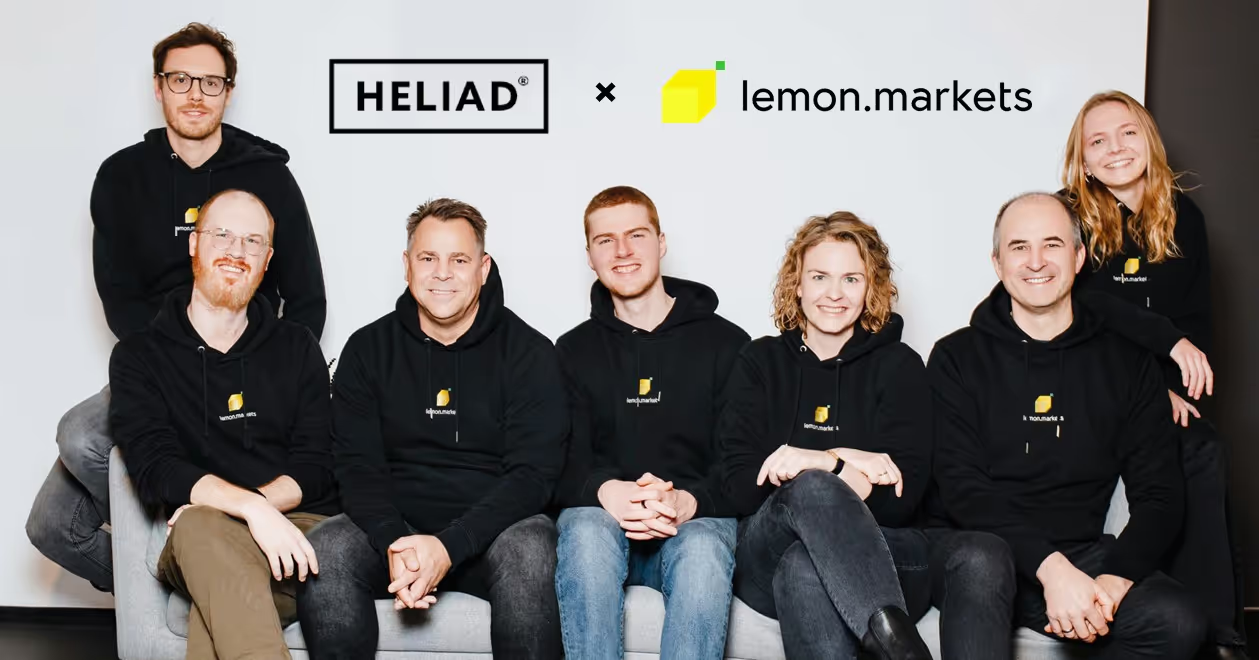
Heliad invests in the Berlin-based brokerage-as-a-service platform FinTech lemon.markets
Frankfurt am Main, July 11, 2024 – Heliad AG (Stock ticker A7A, ISIN DE0001218063) welcomes lemon.markets GmbH to its portfolio

Europe’s location advantage
The startup and venture capital scene is tense – especially in the U.S. Ever since it became known that Silicon
Heliad invests in ARX Robotics to drive European defense innovation with autonomous ground systems
Frankfurt am Main, April 28, 2025 – Heliad has announced its participation in ARX Robotics’ EUR 31m Series A funding